LEHANE LETS YOU LIVE BY NIGHT, DAY AND DANGEROUSLY IN THIS SLICK CRIME TRILOGY

Standard

Live By Night CvrDublin is currently witnessing a very bloody feud between two rival drug gangs, which to date has claimed 5 lives since last September, including that of an innocent man in what is being thought to have been a case of mistaken identity. Not that the perpetrator is going to feel any sense of remorse, murder is murder. The so called hit-men carrying out these murders are drug addicts themselves, doing anything to pay off a debt, score a hit or at least stay in the good books of the gang leader. But this is not something unique to Dublin, every major city the world over and down through history has had a problem with gangsters…. Before narcotics became such a booming industry, they dealt in other vices and contraband, such as sex, gambling and in the US especially, alcohol during the prohibition. This brings us to this month’s book group read, its Live by Night by Dennis Lehane.

Joe Coughlin comes from a good Irish – American family, in 1920’s Boston. Aged nineteen he and couple of friends hold up an illegal poker game, that’s when he meets Emma Gould, the hostess at the game. He falls for her instantly, but she’s also the Moll of a local gangster Albert White. When their next heist goes wrong and two cops die, Joe hides the money he is holding and then flees the city but not before taking Emma with him. Unfortunately, they run into Albert, whose men beat Joe to within an inch of his life. He’s only saved from certain death by the arrival of his Police Commissioner Dad and a large number of the Boston PD. He is sent to jail for the murder of the two cops. Inside he comes under the protection of Mafioso Tommaso Pescatore, from then on he starts on the road to becoming a leading figure in the mafia. On his release he goes to where he hid the money, but it’s gone and he’d given the location to Emma just before the run in with White and his men. She was last seen leaving with one of Albert’s men. Can Joe find Emma? His money? Will he get revenge on Albert White for the beating?

When we discussed this book at book group, I was surprised by a number of the group who said it was violent and they felt uncomfortable reading it. One person said they had to stop for fear of being desensitized!!!! Myself and others argued that there are more violent books out there and we see much more dramatic stuff on TV. They told the group they avoid these types of books and programmes for the same reason.

If we were all to stop reading crime fiction tomorrow for fear that it will have an effect on our moral compass, then a lot of excellent writers would suddenly find themselves out of work. The same goes for cops and pathologist, how do they deal with the sights they see on a daily basis? They learn to switch off. They use mortuary humour and that’s not desensitizing, its coping.  Crime fiction is what it says on the proverbial tin. Fiction!!!! If you feel the material is too graphic it’s down to two things a) the writer’s skill and b) your excellent imagination.

Another member said the women portrayed in the book were just being used… well they were mainly prostitutes. This is what the mafia did back then and still do these days, ran brothels. I don’t know what that contributor was expecting to find in something set in the 1920’s underworld? Women like those in Sex In The City?

Yes, the book is violent but no more than you’d expect from a work of fiction dealing with the subject matter. If you’re expecting Cecelia Ahern or Beatrix Potter you’ve opened the wrong book.

dennis-lehane

Dennis Lehane

I found the book to be a gripping and excellently written crime drama from one of America’s leading crime writers. It tracks Coughlin’s life from the streets of Boston and the wit shredding life in jail, to his new life as a bootlegger, rum runner and eventual heavy weight gangster in the steamy tropics of Florida and Cuba, without any loss of pace or tension. The book is in the similar style as those early works of Jeffery Archer such as Kane and Abel, The Prodigal Daughter and First Among Equals.

This is the first Dennis Lehane I’d read, although I’d seen the Film of Gone Baby Gone. While my Fiancé has been trying to get me to watch Shutter Island for a couple of years now and Mystic River is on my watch list too.

Published in 2012 by William Morrow / Harper Collins (www.harpercollins.com ) Live by

Ben Affleck LBN

Ben Affleck – On Set

Night is the eleventh of thirteen books American author Lehane has written to date. Born and raised in Boston, he still lives there and sets most of his books there. His first six books featured the protagonists Kenzie and Genaro. While Live by Night is the second book in a Trilogy that follows the lives of the Coughlin Clan, the other two are The Given Day (2008) and World Gone By (2015).  The film adaptation is due for release in 2017 starring Ben Affleck as Coughlin, Robert Glenister as White, Sienna Miller as Emma Gould and Brendan Gleeson as his dad. He’s also written for the TV series The Wire, while the movie The Drop was based on a short story of his.

So if you feel your nerves can stand an excellently written crime thriller, then get down to your local bookshop or download a copy and with summer starting make its first warm rays felt on our cheeks, this book and the other two in its trilogy should make excellent holiday reading.

SINCLAIR’S THIRD BOOK LEAVES YOU HUNTING FOR THE CAN’T PUT DOWNABILITY

Standard

Hunt F Enemy cvrThe Russian dissident Alexander Litvinenko was murdered in London in October 2006, when his tea was spiked with Polonium 210, a highly poisonous radioactive isotope. Earlier this year the British government published the findings of the inquiry into his murder, it found the order to kill him most probably came from Vladimir Putin himself. The murder has all the hallmarks of a scene from a leading spy thriller. Among other mysterious political deaths in London over the years, was the murder by the KGB of Bulgarian dissident Georgi Markov in 1978, while he waited at a bus-stop. Then the killer used a poison tipped umbrella filled with Ricin. What these two incidents prove among other things is that nothing is impossible and in the world of Thriller writing, life can oh so very easily imitate art. This brings us on to this month’s book which is Hunt for The Enemy by Rob Sinclair published by Clink Street (www.bookpublishing.co.uk), at the start of this year.

Carl Logan is a British agent working for the JIA (Joint Intelligence Agency), on the run in the harsh Russian winter from, it seems, everyone who could probably want to do him harm. The Russians; his own employers; the American’s and the British. Both he and an old flame Angela Grainger are being set up and blamed for the murders of a number of Russian agents, whilst the American’s want Carl for the murder of the Attorney General and the British want him for the murder of his boss. Can Carl and Angela prove their innocence and stop someone with links to the CIA / JIA and KGB doing a bit of spring cleaning in their names?

It’s usually very hard to read a book which is the third instalment in a series, as is the case with Hunt for The Enemy, I would normally prefer to start from the beginning. But Rob Sinclair sent his latest book to me just before its publication and when an author contacts you and asks to you review his book, I’m not going to turn them down, especially if I want more submissions sent to me – Also I like this genre of book normally so didn’t mind.

Alexndr livinko

Alexander Litvinenko 

There is some back story. The author tries more or less to fill in what you’ve missed out on in the two previous books. There’s the usual plethora of acronyms and espionage terminology which if you’re not into this genre, you won’t be reading it anyway. The whole storyline is very espionage by numbers, with the lead character being a non-conformist “out on a limb” agent with a murky if non-existent past… Bourne-esque and Bond’ish, are terms that spring to mind.

The plot does jump back and forward in time a bit which is a personal bugbear, but I let this go as it moved the story on. There is a glut of characters which had me almost needing an index next to me so I could go, “Oh yeah, that’s him or her again…”.

Rob Sinclair

Rob Sinclair

This is the third book in “The Enemy” series by English author Rob Sinclair (www.robsinclairauthor.com), the previous two are Dance with the Enemy and Rise of the Enemy. The former accountant started writing in 2009, after promising his wife he would write a “Can’t Put Down” thriller.

The thing about making such a bold statement is that you have to live up to it. Most successful authors rarely write “CPD” books consistently especially in the case of trilogies. Usually the first one is good and the next two dine out on their eldest sibling’s success, but rarely are they stand-alone pieces of work, this is the case here.

Rob has written a “Can’t Put Down” thriller- but it was probably the first one. Although at just over three hundred pages long, this book will keep you occupied for the first couple of days of your holiday not just for the first couple of hours as in the case of a “CPD” book. But before you pick this up, download it or walk into your local bookshop and buy the first two installments, then decide if you really want to bother hunting for the enemy.

1916 MAYBE A LONG LONG WAY, BUT BARRY’S BOOK STANDS OUT AS AN EXCELLENT TRIBUTE TO A DIVIDED NATION

Standard


long_long_way CvrIRISHMAN AND IRISHWOMEN: In the name of god and the dead generations from which she receives her old traditions of nationhood, Ireland, through us, summons her children to her flag and strikes for her freedom…” The opening lines of the proclamation read by Patrick Pearse from the steps of the General Post Office in Dublin on Easter Monday 1916.
If you are Irish, have any Irish blood or tenuous connection to the emerald Isle and are looking for a  book to mark the 100th anniversary of 1916? One that evokes the complexity of the time rather than a flag-waving polemic or a nostalgic romp? Then this months book should definitely be top of your list. Its Sebastian Barry’s “A Long, Long Way”.

Published in 2005 by Faber & Faber  www.faber.co.uk  (and shortlisted for the Man Booker prize that year) Barry’s novel stands head-and-shoulders over the many recently published books on all conceivable aspects of the time.

It has no heroes. No impossibly romantic figures who bestride history with emotion-stirring rhetoric or valiant deeds. It tells the story of Willie Dunne, a young Dubliner who had the misfortune to be born in 1906.

When we first meet Willie he is seventeen, working as a builder’s apprentice and in love with Gretta, the daughter of a man who has been blacklisted because of his involvement in the 1913 lock-out.  Willie’s father is a superintendent in the Dublin Metropolitan Police and, to both Willie’s and his father’s disappointment, Willie has not been able to follow in his footsteps because he doesn’t meet the six-foot height requirement to join the constabulary.

Despite this disappointment, Willie enjoys building work and looks forward to a future with Gretta – a future woven into family and place, like his father and grandfather before him.

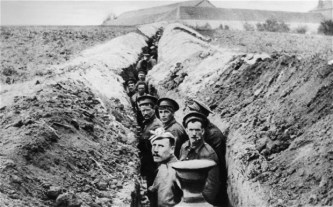
But the world has different plans. 1914. The “Great War”.  Able-bodied young men wantedTrench pic 2 to join the Royal Dublin Fusiliers. For Willie it’s the chance to don a uniform – “if he can’t be a policeman, he can be a soldier” – and to gain his father’s approval.
So, at 18 off Willie heads to war, waved on by cheering crowds. And like the millions of other young men of Europe who headed to war, what awaits Willie in Flanders is the unimaginable squalor, futile slaughter and desolation of the trenches.

Barry’s description of the unconscionable horror of trench warfare is realistic, evocative and, at times, poetic. But overall it’s impact is an echo of the many other poets and writers who have gone before. Sasoon, Remarque (All Quiet on the Western Front) and, more recently, Pat Barker’s Regeneration Trilogy have so exquisitely – and excruciatingly – mined this material that Barry has little to add.  But the inhumanity and terror of the front is only a part of Willie’s undoing.

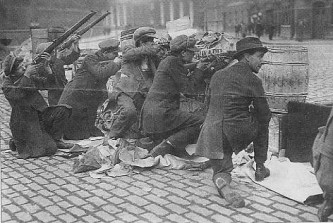
Unlike their other British and French counterparts, for Willie and many of the hundreds of thousands of  Irishmen who were waved off to war by cheering crowds, a return to cheers, gratitude and appreciation of their sacrifice was not to be. Fate had another curved ball to throw at them. The 1916 Rising.

How the Rising affected the men fighting in Flanders, as experienced through Willie Dunne, is the unique perspective that Barry brings to this aspect of our history.

“And in from Ireland trickled the names, every day two or three, of the executed, sending some Dublin men into sore dances of worry …………..and the precious cargo of their children tormenting them, calling to them to return home. And they could not”

Barry lays on the unsettling and disturbing effect of the Rising a bit too thickly when, 1916-risinghighly implausibly, Willie is called up to take part in a battle against the insurgents while on his way back from brief leave in Dublin. Even without this clumsy episode, Willie’s experiences at the front could not fail but to prompt  questions about his own identity and sense of belonging: One of his company is executed for refusing to fight in a British uniform in protest at the killings back home; English officers treat him with disdain because he is Irish; ‘fellow’ soldiers regard “the Irish” as suspect. In effect, Willie and his Irish comrades are good for cannon fodder, but can’t really be trusted.
In a letter home Willie refers to his sense of ambiguity about where his loyalties lie. As soon as the letter is sent he realises he has made a mistake – his father, who has spent his life defending the realm, will be infuriated. And he is – so much so that, when Willie is next on leave his father refuses to see him or let him stay at home. On this leave Willie also finds that Gretta has married and had a baby. He is spat on by street urchins because he is wearing a British army uniform.

“He knew he had no country now………..he feared he was not a citizen, they would not let him be a citizen” His country had “dissolved behind him like sugar in the rain”.

His home now was at the front, with the small band of Irishmen who had been through what he had been through. Who knew what it was to belong only in no-mans-land. Willie returned to inevitable death because he had no place else to go – and no future to hope for.

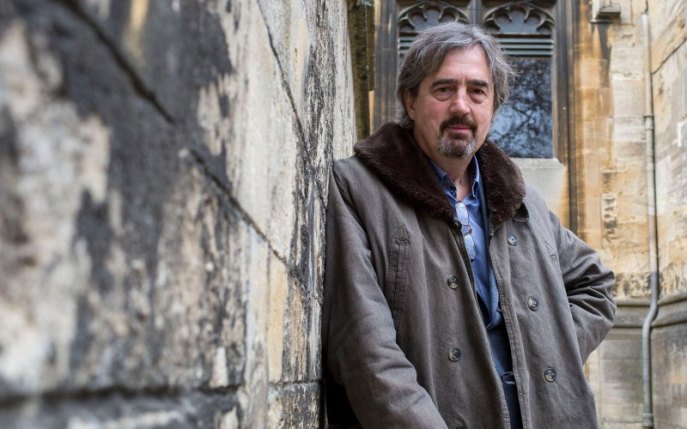
Sebastn Barry

Sebastian Barry

The Long Long Way, is the fifth of Irish author Sebastian Barry’s ten books, which include Macker’s Garden (1982), The Engine Of Owl-Light (1987), Annie Dunne (2002) and The Secret Scripture (2008). He’s also written fourteen plays and two collections of poetry. He’s held academic posts in the US and Ireland and now lives in Co Wicklow. He not only has a magic touch when comes to his literary career but also in his family life too having christened one of his three kids Merlin.

In any context Barry’s depiction of Willie Dunne’s short life is a powerful portrayal of how the circumstances of a time can take over and destroy lives.  In the context of remembering 1916 it is particularly poignant – and a reminder that many Willie Dunnes were dispossessed of a country, of place to belong, through no fault of their own.

Those who did survive and return to Ireland faced such social antipathy that, in effect, they were not allowed to refer to their past. In our book club discussion four people had stories of family members who kept their role in the first – and second – world wars secret for fear of being labelled ‘traitors’.  It is only in this generation that the Willie Dunnes, or more accurately the descendants of the Willie Dunnes, have been allowed to tell their stories.  In a small way the nomination of “A Long, Long Way” as Dublin’s 2007 One_City_One_Book marked a welcoming back to Dublin of all those Willie Dunnes.


You smug-faced crowds with kindling eye
Who cheer when soldier lads march by,
Sneak home and pray you’ll never know
The hell where youth and laughter go. (Suicide in The Trenches – Siegfried Sassoon)

BEECH BRAVELY SETS SAIL IN THIS DEBUT LOADED WITH FACT, FICTION AND TEMPER TRANTRUMS

Standard

You’re pHow to b brve cvrrobably aware that Diabetes has been in the news recently owing to the announcement that researchers have successfully implanted insulin producing cells into mice. Thus taking large steps toward curing this debilitating disease which affects 6% of the worlds adult population. According to the website www.diabetes.org.uk figures released in November 2015 showed that there are currently 3.5 million people in the UK with diabetes. Unlike the UK, there isn’t a national register of diabetes sufferers in Ireland. In 2013 the international Diabetes federation estimated the figure at 207,490. I know at least two people with it, one being my brother-in-law. I don’t know any children with it, although according to Diabetes Ireland www.diabetes.ie there were 2.750 people under the age of 20 with type 1 diabetes according to a paediatric audit in 2012. Type 1 diabetes is 50 times more common in those aged under 18 and the peak age for diagnosis is 10-14yrs. Thus we come to this month’s book – it’s How To Be Brave  by Louise Beech.

The book tells the story of Natalie Armitage an army wife and her nine-year-old daughter Rose.  The two of them lead a sheltered existence in their home in the suburbs of Hull. It’s Halloween and they are dressed up ready to go trick or treating, when Rose suddenly collapses, along with Natalie’s world and their lives as they know them. Later in the A&E, while waiting to hear what’s wrong with her a daughter, a familiar old man appears beside Natalie and comforts her but when the nurse comes to break the life changing news that Rose has Type 1 diabetes, the old man is nowhere to be seen, just the scent of Sea and Salt. Over the next couple of days their lives are turned upside down with the rather sharp learning curve that comes with  getting used to the strict regime of insulin injections and the rapid deterioration of Rose’s personality. One day she is a sweet slightly annoying nine-year-old, then behold an out of control brat. Poor Natalie has to try to get to grips with the diabetes routine, her husband Jake’s absence serving in Afghanistan and the monster possessing her daughter. But the mysterious old man troubles her and unbeknownst to Natalie is visiting Rose in her dreams, until she goes missing. When she is finally found after a frantic search, she tells her mum the old man led her there to find the book. The book in question is a diary belong to Natalie’s Grandad Colin Armitage a merchant seaman whose ship the SS Lulworth Hill was torpedoed off the African Coast in 1943. The diary records his life in the life raft following the sinking. The mother and daughter reach an agreement that Natalie will read the diary to Rose in return for letting her mum administer the injections, which up until then has been the major source of hostilities between the two. Will Colin’s ghost and the story of his sacrifice and bravery while adrift at sea be the tentative bond to aid mother and daughter through the initial trying stages of their new life. Also what of Colin’s story? Do he and the other fourteen occupants in the life raft survive…?

I have to get this off my chest first and foremost, never have I felt such an over-riding urge to slap a character in a book as I have with Rose. Even before she collapsed she was starting to get on my nerves. But afterwards there were times when I just wanted to scream, even throw the book down out of utter frustration.Natalie like most parents these days is up against kids who know the law better than the generations before them and thus play up to their parents and authority figures at every turn.

Louise Beech

Louise Beech

According to the author H.P. Lovecroft “ The oldest and strongest emotion of mankind is fear, and the oldest and strongest kind of fear is fear of the unknown“. Yes, this maybe the main driver of Rose’s rebellious streak –  but the utter contempt with which she treats her mum is scandalous.

As for Natalie, I have nothing but sympathy for her and predicament she finds herself in although despite numerous offers of help from family, friends and Social Workers, she shuns the advice to seek counselling, when you can clearly she is out of her depth and just treading water. Deep down she’s a mother first and foremost thus she knows that her daughter’s change in character is down to the chemical imbalance and her body’s desperate attempts to recover.


The main thing that kept me reading and the two main characters going forward was Colin’s story. It is a truly dramatic and harrowing read but strangely enough a true story. Colin Armitage is actually Author Louise Beech’s grandfather and was aboard the Lulworth Hill when it was sunk by an Italian Submarine in the South Atlantic on the 19th March 1943.  It’s a real eye opener to life adrift at the mercy of the currents and surviving on milk tablets, Bovril tablets, biscuits and a couple of ounces of water a day, having just read We Die Alone by David Howarth, Colin’s experience comes a very close second to it in the endurance stakes.

This is English author Louise Beech’s first book, published in 2015 by Orenda books www.orendabooks.co.uk she’s no stranger to the sea and travelling having been a travel writer for a local Hull newspaper for years, while having her first play performed on stage at the Hull Truck Theatre in 2012, where she also works as a front of house usher.

SS Lulworth Hill

SS Lulworth Hill


The whole book is a marrying of two very large chunks of truth and a dollop of imagination to stitch together Colin’s story and Louise’s experiences of coming to terms with a child diagnosed with Diabetes. It makes the book a very good read and one that should get onto the Book Club circuit quite quickly if it hasn’t already.

I was sent my copy by the good people at Orenda Books. I can definitely recommend you get this debut novel, I’ll be keeping a sharp eye out for future books by an author who definitely knows how to press one’s buttons and keep you engrossed.

THE COLD WON’T BOTHER YOU AGAIN AFTER READING HOWARTH’S TALE OF WARTIME ENDURANCE

Standard

We Die Alone CvrImagine you’re living on the outskirts of a small rural village or in an isolated farmstead – in Nazi occupied Norway, north of the Artic circle.  On a bitterly cold, dark, mid-winter evening there’s a knock on your door. You open it to find a wounded and disheveled stranger, close to exhaustion. He’s on the run from the Nazis. He needs you to feed and shelter him. You know that if you do, you will be tortured and killed if found out. Not only you, also your children – who are sleeping upstairs – could also be killed to make an example of “collaborators” or transported to a ‘labour’ camp.
What would you do?

This is the recurring real-life dilemma faced by housewives, fishermen and villagers when Jan Baalsrud lands on their doorstep in this month’s book, it’s We Die Alone by David Howarth.

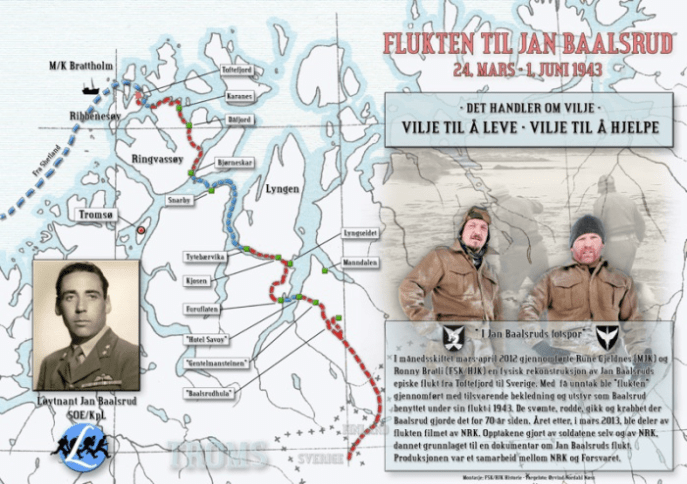
Jan Baalsrud is not a fictional character. He was a Norwegian commando sent from England as part of an under-cover sabotage mission to organize and supply the Norwegian resistance during World War II.   The mission goes horribly wrong when, having sailed from Scotland to a remote bay north of Tromso, the leader of the mission reveals their identity to a local store owner who they have been told is a trusted contact. Too late they realize that their contact has died a year earlier and the new owner of the store, who has the same name, is terrified.  The message on a poster in his own shop: “Contact with the enemy is punished by death” is no idle threat. He calls a friend in the Department of Justice. Next morning a German gunboat sails into the bay.

The ensuing battle results in 11 of the 12-man commando unit being killed or captured (and subsequently executed).  Only Jan – wounded and minus a boot – escapes into the adjoining snow-covered hills.

So begins Jan’s epic 68-day escape journey across artic Norway to eventual safety in neutral Sweden.  Actually, epic doesn’t even begin to describe it. Add heroic, superhuman and phenomenal and we get a little closer – but it is difficult to find the superlatives to truly do justice to what Jan Baalstrud endured over these 68-days.

Jan's Jrny

The Route of Jan’s Epic Journey


Evading capture was only one of his many challenges. The harsh conditions of the Artic mountains presented an even more formidable threat.  Caught in an avalanche, he survives a 300ft fall that leaves him concussed, hallucinating and snow-blind.  He suffers severe frost-bite and starvation. Unable to walk because of a gangrenous leg, he endures days on a mountain lying in a hole in the ice under a boulder – his “snow grave”.  His physical perseverance is phenomenal, but even more impressive is his mental resolve and determination – superhuman is what comes to mind.  What other word adequately describes the level of resolve required to methodically amputate his own toes to rid himself of gangerene while lying, wet and cold, under a rock? Or to doggedly maintain a daily routine of basic survival tasks when convinced that he has been abandoned?

Jan’s courage and bravery are without any doubt exceptional and deserving of fulsome admiration, even adulation. But it is those who help him – the housewives, fishermen and

Jan Baalsrud

Jan Baalsrud

villagers mentioned above, the ordinary Norwegians on whose doorstep Jan appears – who truly deserve the accolade of ‘heroic’.  With the sole exception of the aforementioned shop owner, every single person who Jan seeks help from gives it willingly. They hide him, provide him with food from their meagre war rations, haul him in a stretcher up a mountain, drag him in a sled across a treacherous plateau – all the while putting themselves in mortal danger of being caught and executed and endangering their families. And when Jan reaches safety in Sweden, they remain with this danger still hanging over them like a sword of Damacles. For two more years they continue to live with the constant threat that an inadvertent word or an accidental comment might alert the Germans to their ‘treason’. Jan’s courage and bravery was motivated by a powerful desire to survive. The bravery of the men and women who ensured his survival was selfless. They had nothing to gain and everything to lose. Without doubt they are the real heroes of this amazing story.


And the most amazing thing? It’s NOT fiction – it all actually happened. These were real people who acted with astonishing bravery and selflessness to help a stranger who could not have survived without their help.  In this instance, truth is not only stranger than fiction but also much, much more wonderful.

David Howarth

David Howarth

The author, David Howarth, had a direct connection with the story. He was one of the commanding officers of the secret naval base in the Shetland Islands from which the boat that brought Jan and his ill-fated comrades to Norway embarked. After the war he re-traced Jan’s escape route with him and interviewed the people who helped him. This first-hand knowledge is evident throughout – and adds to the readers sense of witnessing inspiring real-life events.


Written in 1955, this was the third of 18 books on military history written by the English author, the others included Sledge Patrol (1951), Shetland Bus (1951), Thieves Hole (1954), Dawn of D-Day (1959), Sovereign of The Seas (1974), The Dreadnoughts (1979) and Nelson: The Immortal Memory (1988). We Die Alone was made into a movie “Ni Liv” (Nine Lives) in 1957 and inspired a 5-part Norweigan TV series in 2012.

The book retains a freshness and immediacy largely due to Howarth’s fast-paced, journalistic writing style. There are a few ‘time-warp’ issues that reflect attitudes that would not be tolerated today but were almost universally accepted at the time – e.g. some comments on the Lapps generate a ‘gulp’ in today’s reader – but these do not detract from the inspiring humanity of the story.

Read this book. It’ll restore your faith in human nature. And as we face into months of ear-bashing by Donald Trump’s hate-filled invective we need to be reminded that we have the capacity for empathetic heroism.

MCFARLANE’S DEBUT IS A HARROWING BUT GOOD READ, THAT LEAVES MORE QUESTIONS THEN ANSWERS

Standard

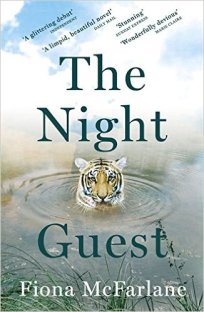
The Nght Gst CvrWe often lament about life in a perfect world. Well in a perfect world there would be no death, no old age, no hunger- or would there? Of course there would. After a while the place would get over crowded if that was the case. But would people have enough money, food? Would there be no homelessness, crime, cruelty etc. ?

If it really existed could we live in such a wonderful place? Wouldn’t we get sick of it after a while? Well we don’t have to worry about it, our world isn’t totally perfect. We have crime, hunger and war.  We have people who prey on the weak because they know they can, owing to the fact that our law is an ass in certain respects and so the indefensible get lost and fall between the cracks of our hulking, overburdened legal systems. This brings us on to this month’s book, it’s The Night Guest by Fiona Mcfarlane.

Ruth is an elderly widow living in New South Wales, Australia. She lives by herself in a small bungalow overlooking the sea and may suffer from the early stages of dementia as she thinks there’s a tiger loose in her house. This is possibly a convoluted memory from her youth growing up in Fiji. She often disturbs her son by calling him in the early hours of the morning to tell him she hears the tiger. One day a yellow cab pulls up outside the house and moments later Frida appears at the back door with a suitcase in tow, telling Ruth the government have sent her to look after her. Initially Ruth accepts this along with her sons. Over time certain strange things start to happen and then Ruth discovers Frida has been living in her spare room. Their relationship goes from one of initial acceptance on Ruth’s part to distrust and subtle hostility, not forgetting the all but non-existent tiger in the midst of this.

This is both an intriguing and harrowing book to read, from the start you really want to see where the whole tiger story line will go (it doesn’t), but then rather quickly it turns into an elderly abuse story line as certain things don’t really add up. The fact that Frida says that the government have sent her to be Ruth’s carer was the first alarm bell for me. Nowhere that I know of, especially in Australia, do the government send carers to elderly people’s private homes.  It would cost too much. Especially with the elderly population across the world increasing significantly owing to the increase in life expectancy.

At first you start questioning what’s going on between the two of them and whether anything untoward is happening. After a while though when things become quite obvious you feel helpless to what is going on, especially when Ruth is forced by Frida to withdraw a large sum of money from her account. You are hoping a friend, a neighbour. the bank or even her family will step in and stop this sham. It reminded me of the sexual assault public Service advert on UK TV recently; the young rapist is seen reliving the act again from behind a pane of glass and banging helplessly on it, yelling at his alternate self to stop.

The incident at the bank, was one of the main flaws that came up in the book group discussion, because I would have thought an elderly woman withdrawing a couple of hundred thousand Australian dollars from her bank would ring a few alarm bells, especially if she is presumed by her family to have early signs of dementia. But no, and this is the point at which things start to unravel on both sides.

Fi McFarlane 1

Fiona McFarlane


This is Australian author Macfarlane’s first of two books. The Night Guest was published in 2013 by Hamish Hamilton in Australia and in the UK by Sceptre in 2014, her second book The High Places – a compilation of short stories is due for publication in February 2016.

The book at times had resonances to Lord of The Flies, with Simon, Ralph and Piggy in the form of Ruth and Jack and the grown up boys represented by Frida and the island is the house.

The love interest, if you can call it that is a nice interlude and again you want it to lead toLord of the flies cvr a nice happy ending, but alas again you are left wondering is this just something brought on by either Ruth’s faltering memory or Frida’s possible drugging of Ruth to keep her quiet. The whole book is just like Emma Donoghue’s Room. It’s subject matter is something we’d hate to read about in a newspaper, but have to all too often. As a book though it is the basis of an interesting if at times uncomfortable read, but unlike Room, there isn’t really a happy outcome of sorts.

The book, does leave you with a lot of interesting questions, which led to a healthy debate among the book group especially when you ask yourself the question, is Ruth really suffering from dementia? Could the sons have done more, or are they guilty of neglect? But in the end the real judge and jury is the reader and so off you pop to your local book store or download it and make your own mind up.

BELFOURE’S WARTIME ESCAPADE WILL HAVE YOU SEEKING A HIDEAWAY TO FINISH THIS TAUT PAGE TURNER

Standard

The Paris Archtct CvrIt may be one of most romantic cities in the world, but with what has been visited upon the French capital in the past twelve months, you’d think I’d be turned off going there. On the contrary, this makes me more determined than ever to fan the flames of love in its various arrondissements, walking hand in hand along the banks of the Seine or sittiing outside it’s cafe’s and boulangeries drinking coffee and nibbling fresh flaky croissants while admiring the architecture. Thus bringing us on to this month’s book – it’s The Paris Architect by Charles Belfoure.

As Lucien Bernard the Architect of the title, rounds a corner of a street in Paris he almost bumps into a man running in the opposite direction. In the split second that it takes for the man to pass, Lucien notices that he is wearing the same cologne as himself. He hears a gun shot, turning he sees the man is lying dead on the pavement behind him, blood pouring from his head. He is a Jew.

This opening scene from “The Paris Architect” reflects the tone of the book.  Set in 1940’s Nazi-occupied Paris, the book explores the intersection of normal, everyday life with the terror of living-on-the-edge, where being in the wrong place at the wrong time could mean death, torture or deportation to a prison camp.

The book’s central character, Lucien, is a handsome young architect battling with the deprivations of occupied Paris – little work, scarcity of food, rationing. Self-centered and egotistical, as the story begins Lucien is frustrated that the war has deprived him of the opportunity to display his modernist architectural talents and, in the process, becoming rich and renowned, achieving the social status and acclaim that he, by his own lights, truly deserves.

On the morning of the shooting, Lucien is heading for a fateful meeting with a rich industrialist, Auguste Manet. He is expecting a commission to design an armaments factory for the German military. Manet’s proposition is, however, entirely different. He wants Lucien to incorporate a secret hiding place in an apartment that is to be used to accommodate a Jewish friend until he can be moved to safety.  Lucien’s horror at being asked to do such a dangerous task is only slightly assuaged by the very large sum of money that Manet offers. Even the indication that this would lead to the expected factory commission does little to persuade Lucien to take on such a suicidal job. The hook that reels him in is the architectural challenge. He envisages an elegant solution, an ingenious hiding place that no Gestapo search party would find…

So begins Lucien’s transformation. As his fascination for devising architectural solutions

Priest hide

Inspiration – A Priest Hole

draws him into a life-threatening web of secrecy and intrigue, Lucien’s arrogant self-confidence is challenged by tragedy and by exposure to the self-sacrifice and bravery of others. A very unlikely hero emerges.


Lucien is soon leading a double life – surreptitiously visiting apartments to design hiding places while also socialising with German officers to progress his factory proposals. As his life becomes more and more dangerously complicated – he becomes friends with a Wehrmacht officer, the Paris Resistance targets him as a collaborator, his mistress takes a Gestapo lover, he takes in an orphaned Jewish boy  – the tension and terror heightens.

And it isn’t only Lucien’s life that generates nail-biting tension. Balfoure’s description of the coldly casual brutality of Nazi killing of civilians is truly shocking, bringing home what it must be like to live under a reign of terror.

It also raises uncomfortable questions for the reader. What would we do if we were faced with a similar situation? Would we risk our life and those of our family to protect others from atrocity? Or would we adopt Lucien’s wife approach that “in wartime, Christian brotherhood takes a back seat to saving one’s own skin.”

Balfoure’s description of the sadism of the Gestapo and the grotesque consequences for those found helping Jews – and even those who are only living in the same apartment block – brings into sharp focus why it was that ordinary people in Germany and occupied Europe looked the other way and ‘allowed’ unconscionable atrocities to be carried out all around them. I, unfortunately, have to admit that I would do the same.

charlesbelfoure-headshot

Charles Belfoure

An architect by profession, this is Balfoure’s first book of two works of fiction, published in 2013, the other is House of Thieves published last year (www.charlesbelfoure.com). The idea for Lucien’s ‘hook’ is based on the actual incorporation of secret hiding places for persecuted priests in houses of Catholic sympathizers during the reign of Elizabeth 1st.    Balfoure’s own love of architectural problem-solving is evident throughout. Although spatially challenged, even I found his descriptions of the design of hiding places compellingly fascinating, making Lucien’s risk taking and subsequent transformation wholly believable.

Written with a true story-teller’s flair, the narrative unfolds at a fast, page-turning pace – until close to the end, which is disappointingly clichéd (written with a film deal in mind?).  Despite this one reservation, it’s a really good thought-provoking read.

_________________________________________________________________

We’d like to take this opportunity to wish all our readers and followers on the various social media a very happy New Year. Thanks for stopping by and for spreading the word. We hope you enjoy the book reviews that we’ve have left  beyond The Library Door  and will continue to leave over 2016. Adrian

ENRIGHT’S GREEN ROAD IS SO FAR OFF THE BEATEN TRACK, EVEN YOUR SAT NAV WOULD TELL YOU TO AVOID IT

Standard

green-road cvrA couple of weeks ago my Fiancée and I went to a local Tapas restaurant, we’d been given a voucher by a neighbour for rescuing their cat from being savaged by dogs in the wee small hours of a Saturday morning a couple of weeks previously. The cat subsequently died en route to a 24-hour emergency veterinary hospital. Anyway back to the Tapas restaurant, my Fiancée doesn’t get Tapas, as opposed to ordinary restaurants where you read the menu and order a dish for starters, main course and desert. Whereas in Tapas it’s basically order small dishes from all over the menu as often as you want until you feel full. Me I was brought up by a father who told me to go through life with an open mind and equally broad palate. My Fiancée on the other hand will never get Tapas and that’s fine, because that brings me to this month’s book. It’s The Green Road by Anne Enright.
Anne is a local author, well she was until recently, when  she moved from Bray further into south County Dublin. Like my fiancée and Tapas, I’ve never liked Anne’s work and probably never will. It may come down to the fact, that I believe there is a lot to being Irelands Inaugural Laureate for Irish Fiction then winning The Booker. There are bigger and better Irish writers out there who’ve never won an  award and are more deserving of this title – One swallow does not a summer make.

anne-enright-600

Anne Enright – On Bray beach


The book deals with emigration and the family and how it grows apart as time goes by. Rosaleen Madigan is an elderly woman living on the west coast of Ireland, her four kids have all flown the nest and made new lives for themselves, some far beyond these shores. One day she decides she’s going to sell the family home and divide the proceeds. The brood  are summoned home for one last Christmas, which leads to their various idealologies and ego’s competing for attention in this confined space. Then amidst this fractious atmosphere Rosaleen goes missing. Will they find in her in time, out there in this barren and unforgiving countryside on a stormy Christmas day? Will the children pull together in this crisis?

The Green Road isn’t a great book it’s an okay book, it reminded me of most of the middle of the road American drama’s you see on Hallmark TV, set in the Midwest about family’s gathering for thanksgiving. It’s people coming from far and wide to spend one day in each others company. We don’t like it, we do it because its tradition and we hope it’ll be all happy families, it’s usually a very poor attempt. That’s mainly down to the pressure to live up to the images presented on TV, magazines and newspapers.  Just like that, this story is a well worn one and it’s been done on film and TV much better, the characters are stereotypical , there’s a gay member of the family, a brother who is trying to find himself by doing charity work in Africa and a sister who does everything for everyone but never gets any thanks .

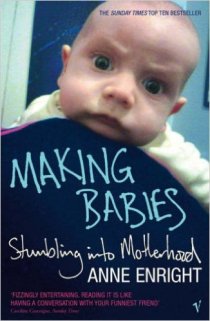
I may have read all the way through the book, that doesn’t mean I liked it, Imaking babies cover only it finished because she is or was a local author and I felt I should give her the benefit of the doubt. Hah! It was a waste of time; I could’ve easily thrown it down after the first couple of pages if I didn’t know her. The start is laborious and even though it picks up pace slightly midway, the ending is predictable.


This is Dublin born Enright’s ninth book of fiction, published in 2015 by Jonathan Cape. The others include My Portable Virgin, The Wig My Father Wore, The Gathering and Taking Pictures, as well as a collection of short stories called Yesterdays Weather and a book of non-fiction called Making Babies; you can guess what that’s about.

So take my advice, give The Green Road a miss. Take an alternative route to your literary enjoyment. Maybe even see if she can make a better effort on writing about motherhood. Better still go for  Tapas.

YOU’LL BE DYING TO PUT RAVEN’S PACY PLOT DRIVEN MASTERPIECE ON TO YOUR WISH LIST

Standard

Dying Wish CvrOne of the major ingredients for any new house purchase is always Location, Location, Location, so Phil Spencer and Kirstie Allsop would have us believe. The same can be said for thriller writing. Some of the best mystery stories in the past owe their success to the setting in general, even the setting for their pivotal crimes. Morse for example, really wouldn’t have worked as well, if it had been set in Glasgow for example. Nothing against Glasgow, Angels and Demons, owes its success to the backdrop of Rome and the election of a new Pope. The corridors of power in Washington, London, Moscow and the Kremlin, have for years been the biggest draw for readers. Parks are regularly used as the setting for crimes, Central Park features in numerous film and TV dramas, while Gerard O’Donovan’s book The Priest is set in around Dublin’s largest green space, Phoenix Park.  This month’s book is set among the lush green woodland of The New Forest in Hampshire in southern England. It’s Dying Wish by James Raven (www.james-raven.com) published by Robert Hale Books (www.halebooks.com).

According to the book, the New Forest covers around 200 square miles of English countryside, originally a hunting ground for the monarchy it is now one of the UK’s most popular destinations for day-trippers, campers and cyclists. It’s a patchwork of open heath and dense woodland, inhabited by its own breed of wild pony and various types of deer.

Hauntingly beautiful New Forest

Hauntingly beautiful New Forest

Over the years this area’s dark history has given rise to grim legends and withheld sinister secrets, but a few are about to come to the surface. When a local author Grant Mason, whose most recent work has been a series of books on walks around the forest, is taken ill at a book signing in the nearby city of Southampton, his dying wish is for his loyal assistant  to burn his house down. Shocked at this request, she contacts her friend Detective Chief Inspector Jeff Temple, who goes to the house deep in the New Forest to check things out and is attacked when he disturbs an intruder A follow up search of the property reveals an array of unusual objects including a stun gun, explicit photo’s, as well as a map of the new forest with crosses and names marked on it. What initially looks like an open and shut case, soon turns in to a series of missing persons cold cases. As temple and his team start digging at the various sites and discovering bodies, they also find graphic video evidence on a laptop that points to to the likely probability that Mason wasn’t alone. The team were already working on a missing persons case before this; the disappearance of a couple from Southampton. But there names weren’t on the map, so are they connected and if so where are they. The race is on to find the couple and stop Grant’s sexually depraved accomplice before more people are abducted and killed, All the while Temple and his team have their own various personal problems to deal with.

At just over two hundred pages long, Raven’s book doesn’t leave room for niceties its a real ‘wham bam thank you mam‘ hell ride from the start. This is the next best thing to having a sack put over your head , your hands tied and thrown in the back of a vehicle as it has you gripped from page one. This is thriller writing at it’s best, it’s a well thought out and original story set in a vast virginal landscape which would and should give any writer big juicy hunks of inspiration and James has harvested this beautifully.

This isn’t the first time that British author James Raven has broken new ground in original story-lines and settings, his

James Raven

James Raven

previous book Random Targets has Jeff and the team hunting a sniper whose taking pot-shots at rush hour traffic on Britain’s motorways. This is Raven,  a former journalist’s tenth book and his fourth featuring DCI Jeff Temple. The others are the afore mentioned Random TargetsRollover and Urban Myth, the next book featuring DCI Temple is Blogger and will be published in early 2016. His other books include After Execution, Red Blitz, Artic Blood and Stark Warning.

Temple himself is an iconic British detective cut from the same cloth as other modern fictional policemen like Tom Barnaby from TV’s Midsommer Murders, He is flawed and is affected by his personal life, especially in this book.  He’s no Jack Bauer, but he does take stupid risks on a number of occasions, leading to the proof that he is human and also bleeds as well as get battered and bruised not once but at least twice, which is good to see in a protagonist. It’s nice that a suspect can slip away every now and then owing to the fact that he’s knocked the hero unconscious, not through some stupid Hollywood fantastical excuse.

The story-line is not for the fainthearted, the descriptions of the depraved acts committed by Grant Mason and his accomplice are full in your face and gives the real feeling you’re in on the case with Temple and his team. It takes Fifty Shades of Grey to and new dark and depraved level. It left me feeling like I’d been hit with a fully packed rucksack and hiking boots.

So with the nights definitely closing in on us, this is the ideal book to read on dark windy evenings. Then after that I’d go get my hands on his previous books. Because Raven is proof that small, tightly written, plot driven books are cool.

STUFFY ENGLISH VALUES GET TURNED UPSIDE DOWN IN PETTIGREW’S LAST STAND

Standard

Major-Pettigrews-Last-Stand CvrMy partner  and I spent this summer in the delightful Devon village of Colyton, it’s skyline dominated by the steeple of St. Andrews, the village church. A place where you can stroll along it’s winding lanes from one side of the village to the other in 10 minutes and the world heritage site of the Jurassic Coast was just 15 minutes away by a restored tram line (www.colyton.co.uk). For the the two previous years we’ve holidayed in the Derbyshire village of Hayfield (www.visitpeakdistrict.com/High-Peak-Hayfield) the site of the mass trespass in 1932 on Kinder Scout as well as the birth place of Captain Mainwaring himself – Actor Arthur Lowe.

What attracts us to these  quintessentially English villages, is the way everything is so charming and petite, Pubs are quiet and homely and both villages give off a real feeling of community. Compared to the sprawling metropolis we inhabit for the other 350 days of the year, not to mention a love of all those quaint villages which are the setting for many British dramas and comedies. This brings us on to this months book, “Major Pettigrew’s Last Stand” by  Helen Simonson (www.helensimonson.com).

Edgecombe St Mary – a sleepy village in the Sussex countryside. Quintessentially English, it’s upper middle class inhabitants pride themselves on their impeccable manners. When some of the lower-class residents harass the Pakistani couple who have taken over the local shop the “upper echelons of the village… compensated for the rudeness of the lower by developing a widely advertised respect for Mr and Mrs Ali. …  ‘our dear Pakistani friends at the shop’”

Major Pettigrew, who has lived in Edgecombe St Mary since he was a boy, is no exception – “I was raised to believe in politeness above all”.

But the complacent, self-satisfied superiority of the upper echelons of Edgecombe St Mary is about to be challenged. And by none other than Major Pettigrew, one of their own!

Major Pettigrew is an archetypal product of the England that is Edgecombe St Mary.  The values of decorum, respectability and conformity have shaped his life. A 68-year old widower, he lives in a house that he, as the eldest child, inherited from his parents. That this might rancour with his brother  – or more especially his brother’s wife – doesn’t enter his mind. Primogeniture is, after all, what is. When the lord of the local manor starts surveying land adjoining Major Pettigrew’s house to build ‘exclusive’ new homes, the Major shuns his (female) neighbour’s approach of picketing and public protest in favour of a “stern letter to the planning officer” and “looked forward to the entire matter being resolved in an amicable manner between reasonable men”.  

Typical of his type, Major Pettigrew is socially insecure. Maintaining one’s place in the social pecking order is paramount. He rankles if addressed as Mr rather than Major or, worse still, by his christian name, Ernest. (Thankfully only Americans, who are way down in the Edgecombe St Mary pecking order, have the effrontery to do this!). An invitation from the local Lord is a coveted prize to be – casually – mentioned to envious others. Membership of the local golf-club, the ‘sine qua non’ for social acceptability, is jealously guarded – as the Khans, who have donated handsomely to the annual ball find out. “We are quite oversubscribed in the medical profession”.

So what then does Major Pettrigrew do to disturb Edgecombe St Mary’s snobbish complacency? He falls in love. With Mrs Ali, the recently widowed Pakastini shopkeeper.

Helen Simonson

Helen Simonson

For this plot to be anything other than corny – and it is far from that – it has to be written by someone with a gimlet eye for the nuances of English village life and a fondness for the idiosyncratic mix that is the well-meaning English gentleman. Qualities that the author, Helen Simonson, appears to have in spades.  Born and reared in England, she spent her teenage years in a village in East Sussex, so has first-hand knowledge of English village life. After college she moved to the US and has lived there since. It is this distance, both in time and in space, that provides the outsider’s perspective to the insider’s experience that characterises the book and brings it out of the realm of a corny, Woodhouse-style comic romp to a touching, insightful (and comic) human tale. Published by Bloomsbury (www.bloomsbury.com) in 2010 this is her first book, her second The Summer Before The War is due out in Spring of 2016.

Simonson’s insight is evident from the very first pages. The fateful crack in Major Pettigrew’s facade of social decorum occurs when, having just heard news of his brother’s death, he answers the door while wearing his deceased wife’s old floral housecoat (he was doing his weekly housework). On the doorstep is Mrs Ali, calling to collect newspaper money.  The combination of shock over his brother’s death, mortification at being seen in the housecoat and embarrassment for not having the money ready overwhelms even the Major’s inbred ‘stiff upper lip’.  He blurts out “My brother died”.  

So begins a human interaction, unmediated by social niceties, Eng Villagethat shatters the Major’s lifelong adherence to formulaic social norms. Acting outside the accepted behaviour of his group does not come easily to Major Pettigrew, however.

The novel describes his struggle to choose between a second chance at love with its inherent vulnerability, and the familiar, boring security of his habitual conformity.  Thankfully, Simonson’s description of the Major’s struggle does not take the form of dreary introspection and soul searching (what self-respecting Englishman has time for such nonsense?), but is played out in a series of often hilarious and sometimes poignant events that reflect some of the cultural and racial tensions of a changing Britain.