
 Modern day human trafficking has its origins in the African slave trade, the first law against slavery didn’t come into effect until the British parliament passed an anti-slavery bill in 1807. After the African save trade was stopped there was the white slavery, which concentrated on the exploitation and international movement of women and girls for use in the sex trade. Now a days it accounts for an estimated 75-80% of all human trafficking and of that 50% of victims procured for the sex trade are children, which brings on to this months book. Its Epiphany Jones by Michael Grothaus (www.michaelgrothaus.com) published by Orenda books (www.orendabooks.co.uk ) in March 2016.
Boy can Michael Grothaus write! In this, his debut novel, he shows that he can do it all. Explicit sex, nauseating violence, page-turning thriller, tender romance, heart-breaking loss, pitch perfect characterisation – it’s all here. But the ‘piece de resistance’, the outstanding gem, of this novel is Grothaus’s empathetic and insightful portrayal of Jerry, it’s narrator and main character.
When we first meet Jerry he’s working as a Colour Imaging Specialist for the Art Institute of Chicago. Translation – he spends his day in a dingy basement digitally adjusting colours on reproductions of the Institute’s paintings. The job is “one step above a peon and a thousand levels below anyone who matters”. He got the job because Roland, a co-worker, is a friend of his mother.
Jerry’s personal life is also pretty typical of the average twenty-something first-world male. He lives alone amid the debris of his unwashed clothes, is sex-obsessed, lies about having a girlfriend and suffers from bouts of depression. But life has thrown Jerry an extra curve-ball: psychotic hallucinations. At times Jerry – and the reader – doesn’t know if what he’s seeing is real or imaginary.
When Roland is murdered and a Van Gough painting loaned to the Art Institute turns up in Jerry’s apartment, his mundane life takes a turbo-charged swerve into the unknown. Enter Epiphany Jones. A darkly ominous outsider who lives by her wits and has a direct line of communication to God. Jerry first assumes she’s an hallucination – he’s seen her before in a recurring dream. She turns out to be all too real and is convinced that Jerry, and only Jerry, can help her to find and rescue her daughter from sex slavery. Bizarre – but Epiphany can prove Jerry’s innocence so he has little choice but to play along with her.
What follows is a fast-paced thriller that brings us on a tail-spinning journey through the very dark world of child sex trafficking. Grothaus does not spare us. Graphic violence; nauseating exploitative sex; victims murdered, broken and depersonalized by vicious cruelty. Stuff that I would usually run a mile from. But Grothaus’s narrative style is compelling. A truly talented scene-setter (he has a degree in filmmaking), he hooks you in by expertly sketching a sympathetic character and then, wham! Hits you in the solar plexus. But, unlike the vast majority of sex-and-violence writing that comes across as warped fantasy, when Grothaus causes your gut to wrench and the bile to rise, he also has brought your brain to the very clear understanding that this awfulness does happen. IS happening – in your city, likely only a few kilometers away.

How does Jerry fare in all of this? Well, Jerry remains very much Jerry. Grothaus deftly avoids Jerry morphing into a competent, capable, adult. And this is the clue to Grothaus’s ability to get the reader to keep reading through some pretty harrowing material. We’re already emotionally invested in the ‘hanging-onto-sanity-by-his-fingertips’ Jerry, so we have to see how he actually does hang on to his sanity in this grim world. He grows up a little, but he largely remains the same confused, bewildered anti-hero that we first meet. His stratagems and schemes to get out of the mess he’s in invariably fail. He constantly digs more holes for himself. Only to be dragged, usually unwillingly, out of danger by street-wise Epiphany.
Interestingly, Epiphany’s character doesn’t change much either. But as we learn her back-story and see her navigate the tides of the sex-trade underworld our perspective changes. This is not the world for a trusting, approachable character who plays by the rules. Believing that you have an all-powerful God on your side is a very valuable mind-set in this nasty territory.
I do have a few quibbles, however. Grothaus packs too much into this one book. He could have brought everything to a conclusion much earlier. One half of the book is set in the US and Mexico, the other half in Portugal & Cannes. I got the distinct impression that Jerry was brought to Portugal largely because Grothaus wanted to use location material he had from visiting there. The thriller plot also stalls for several chapters while Jerry falls in love with a local girl. The writing is still very good and the characterizations were more than enough to hold my interest. But I thought I was reading a different book.
And the Cannes section? Here Grothaus’s characterisation skill falters and the plot-line frays more than a little. He doesn’t quite ‘nail’ the narcissistic, self-aggrandising scumbags of the movie business who assume an entitlement to destroy the lives of others to fill the gaping hole that once held a soul. And the working out of the plot dénouement becomes far, far to complicated. I’d need a 3-D model of the mansion it takes place in to follow it! It might work on film, but not on paper.
But none of this takes away from the absolutely wonderful portrayal of Jerry – the inadequate mess who tries so hard to get things right and, despite (often self generated) knockbacks and pretty tough odds, keeps trying. I still get teary-eyed about how he blamed himself for his sister’s death. I want to shout out “It wasn’t your fault, Jerry – you were only a kid”. That’s how much Michael Grothaus reeled me in.

Michael Grothaus
Grothaus’s writing ability really shouldn’t come as any surprise. He’s an established journalist known for his writing about internet subcultures in the digital age and with roots in the film industry. He also knows his topic, having spent years researching sex trafficking. True to the mantra ‘write what you know’, he even worked in The Art Institute of Chicago.
In an Irish Times article he wrote earlier this year, he described his motivation for the book “…you write a first-person debut novel about a guy who has a porn addiction and some readers are just going to think it’s autobiographical. I get that. I do. But what those same readers are right about is the anger. That dissatisfaction Jerry feels? That comes from me – at least part of it. And it’s that dissatisfaction, I believe, that is essential to being a good writer…. Dissatisfaction, used wisely, fuels action. It’s what gets you in front of your keyboard to write that story that holds a mirror up to society so it can see itself as it truly is..” .
His first book is a really good read – I’m recommending it to every teenage boy I know (Jerry as a role-model – Yes!). Let’s hope there’s lots more to come.
Reviewed by Clare O’Connor
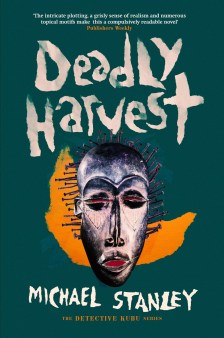 According to the Forbes 2000 list of 2015, the top three pharmaceutical companies in the world were, Johnson & Jonson followed closely by Pfizer and Novartis, together they were worth $722 Billion. It’s feasible that as I write this or you read it, quite a few of your neighbours, members of your family, maybe even you the reader are on one of their medicines. In certain parts of the world, usually below the equator and in under developed countries but not excluding some developing nations, large swathes of the population prefer to rely on another type of medicine. That prescribed by a witch doctor. They don’t make the money that their 1st world counterparts do but they have an equally big following, god like in some instances. In most cases the difference between these witch doctors and your Novartis’s and Pfizer’s is that your local pharmacy doesn’t ask you to supply the raw materials for the cure yourself. This brings me to this month’s book, its Deadly Harvest by Michael Stanley (

 During my wedding weekend in Lincoln in June, Lincoln castle had some very important guests. they were a segment of the 888,246 ceramic red poppies that were installed in the Tower of London in 2014. The poppies represented the British men and women who were killed fighting in both world wars. This isn’t the first time inanimate objects have been used to represent those slain in battle, on the 6th April 2012 an art installation was unveiled on Sarajevo’s main street, it consisted of 11,541 red chairs which represented the victims of the siege of Sarajevo which lasted from the 1992-1995. In the midst of this audience of empty red chairs were 643 little red chairs representing the children killed during the siege, and that is the inspiration for the title of this month’s book, it’s The Little Red Chairs by Edna O’Brien.

 nd has always been seen as an island of saints and scholars and, under the latter you’ll find writers, although not all writers are scholars. Among the many great writers who cut their literary teeth and honed their trade on everything from the Book of Kells to The Sea, The Sea, were women. Every year a brace of new female writers try to emulate the successes of their predecessors like Maeve Binchy, Kate O’Brien and Iris Murdoch. One such hopeful is the author of this months book, its The Priveliged by Emily Hourican published in April 2016 by
 According to the National Center for Missing & Exploited Children 800,000 children go missing in America every year. Down through history there have been high profile cases, such as the Lindbergh baby – kidnapped in 1932 and most recently Madeline McCann who was abducted in Portugal in 2007. Even with the development of Amber Alert schemes, child abduction is an ever present scourge on society. Thus we come to this months book, its In Her Wake by Amanda Jennings published by Orenda Books (

 It was only last year, when I read my first Gunnar Staalesen’s crime fiction novel,
 excuse, I got married. It’s been hard to find time to write and upload reviews for the latter
 Dublin is currently witnessing a very bloody feud between two rival drug gangs, which to date has claimed 5 lives since last September, including that of an innocent man in what is being thought to have been a case of mistaken identity. Not that the perpetrator is going to feel any sense of remorse, murder is murder. The so called hit-men carrying out these murders are drug addicts themselves, doing anything to pay off a debt, score a hit or at least stay in the good books of the gang leader. But this is not something unique to Dublin, every major city the world over and down through history has had a problem with gangsters…. Before narcotics became such a booming industry, they dealt in other vices and contraband, such as sex, gambling and in the US especially, alcohol during the prohibition. This brings us to this month’s book group read, its Live by Night by Dennis Lehane.

 The Russian dissident Alexander Litvinenko was murdered in London in October 2006, when his tea was spiked with Polonium 210, a highly poisonous radioactive isotope. Earlier this year the British government published the findings of the inquiry into his murder, it found the order to kill him most probably came from Vladimir Putin himself. The murder has all the hallmarks of a scene from a leading spy thriller. Among other mysterious political deaths in London over the years, was the murder by the KGB of Bulgarian dissident Georgi Markov in 1978, while he waited at a bus-stop. Then the killer used a poison tipped umbrella filled with Ricin. What these two incidents prove among other things is that nothing is impossible and in the world of Thriller writing, life can oh so very easily imitate art. This brings us on to this month’s book which is Hunt for The Enemy by Rob Sinclair published by Clink Street (

 “IRISHMAN AND IRISHWOMEN: In the name of god and the dead generations from which she receives her old traditions of nationhood, Ireland, through us, summons her children to her flag and strikes for her freedom…” The opening lines of the proclamation read by Patrick Pearse from the steps of the General Post Office in Dublin on Easter Monday 1916.
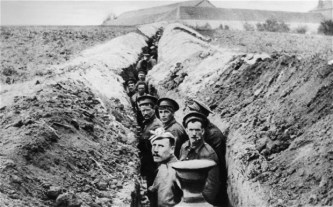 to join the Royal Dublin Fusiliers. For Willie it’s the chance to don a uniform – “if he can’t be a policeman, he can be a soldier” – and to gain his father’s approval.
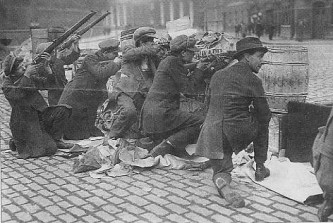 highly implausibly, Willie is called up to take part in a battle against the insurgents while on his way back from brief leave in Dublin. Even without this clumsy episode, Willie’s experiences at the front could not fail but to prompt questions about his own identity and sense of belonging: One of his company is executed for refusing to fight in a British uniform in protest at the killings back home; English officers treat him with disdain because he is Irish; ‘fellow’ soldiers regard “the Irish” as suspect. In effect, Willie and his Irish comrades are good for cannon fodder, but can’t really be trusted.
 robably aware that Diabetes has been in the news recently owing to the announcement that researchers have successfully implanted insulin producing cells into mice. Thus taking large steps toward curing this debilitating disease which affects 6% of the worlds adult population. According to the website

 the library door